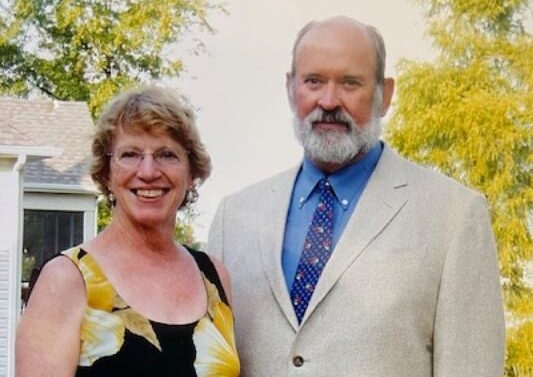
John Hertner’s Gift to Future Biologists
By Robyn Murray
For John Hertner, Ph.D., the journey to becoming a dedicated educator and generous supporter of student success began far from Nebraska — in the sunshine of Florida, where he was raised by two highly educated parents. His father, a naval architect with graduate degrees from the University of Michigan, and his mother, a biologist who earned her degree from the University of Minnesota at a time when few women pursued higher education, instilled in him a deep respect for learning and academic achievement.
“My mother never preached biology,” John, a Burnett Society member, recalled, “but she was so excited about living organisms and the natural world that it rubbed off on all three of her children.”
That excitement stayed with him throughout his life. He remembers walking with his mother in the gardens of her retirement home, when she suddenly stopped to observe ants crossing the sidewalk. “I thought, well, here Mom’s finally lost it,” he said with a chuckle. “But she was just watching ants, and then she launched into a whole lecture about how ants leave pheromone trails for others to follow.”
That lifelong curiosity and passion for biology left a lasting impression on John, leading him to pursue biology himself, eventually earning a master’s degree and later his doctorate, and beginning a career in education that spanned nearly four decades.
After teaching and coaching in Colorado high schools, John moved to Nebraska in 1974 to join what was then Kearney State College. He spent 37 years teaching anatomy, physiology and histology, witnessing the institution’s transition into the University of Nebraska at Kearney. What drew him to UNK, and kept him there, was its commitment to undergraduate education.
“At Kearney, undergraduates were taught by faculty, not graduate assistants,” John said. “There was a strong sense of willingness to work with students to assure their success, without compromising academic credibility.”
John’s impact extended beyond the classroom. He maintained relationships with his former students, many of whom went on to successful careers. His dedication to student success didn’t end with retirement in 2011. He and his wife established a scholarship for biology majors who do not qualify for in-state tuition, students like he once was.
“I paid dearly for being an out-of-state student,” John said. “This scholarship helps students achieve success despite that financial hurdle.” So far, two students — a pre-med student from Kansas and a pre-dental student from Colorado — have benefited from the gift.
John also helped bring a unique resource to UNK’s biology department: an extensive shell collection donated by the family of its original collectors. Recognizing its potential for student research, John facilitated its acquisition, providing hands-on opportunities for biology majors to study and identify diverse phylogenetic groups.
For John, giving back is about more than generosity, it’s about participation. “When you support education through scholarships, you become a participant in someone else’s success,” he said. “You’re not just donating money. You’re contributing to the success of someone who chose the University of Nebraska.”
His message to others who have made a gift is simple: “You’re not standing on the sidelines. You’re part of the academic pursuit.”