By Maddie Pospisil
Inside UNMC’s Groundbreaking Clinical Trials and the Philanthropy Helping to Change Lives
Beth Smith has been living with multiple sclerosis for 25 years, and she always believed there had to be a better option for people diagnosed with this chronic disease. Smith remembers reading about people across the world participating in new, innovative treatments for MS and thinking to herself, What if that could be me?
Late last year, that possibility became reality when Smith became the third person in the world to participate in a first-of-its-kind clinical trial for a new MS therapy.
INNOVATION THAT CHANGES LIVES
Led by Lakshman Narain Arcot Jayagopal, MBBS, MD, assistant professor in the University of Nebraska Medical Center’s Department of Neurological Sciences, the trial is supported by the Gene and Cellular Support Service led by Matthew Lunning, DO. Dr. Lunning, medical director of the Gene and Cellular Therapy Program and UNMC’s assistant vice chancellor of clinical research, specializes in chimeric antigen receptor T-cell therapy, or CAR T-cell therapy. What makes this treatment remarkable is that it trains a person’s body to fight its own disease.
UNMC and Nebraska Medicine have used CAR T-cell therapy since the 2010s to treat patients with lymphoma and leukemia. Buoyed by that success, researchers began exploring new possibilities. UNMC was among the first institutions in the world to use CAR T-cell therapy in patients with autoimmune diseases such as lupus and multiple sclerosis.
The clinical trial Smith participated in used allogeneic CAR T-cell therapy, in which T cells from a healthy donor are genetically modified to target and destroy the harmful immune cells that drive autoimmune disease.
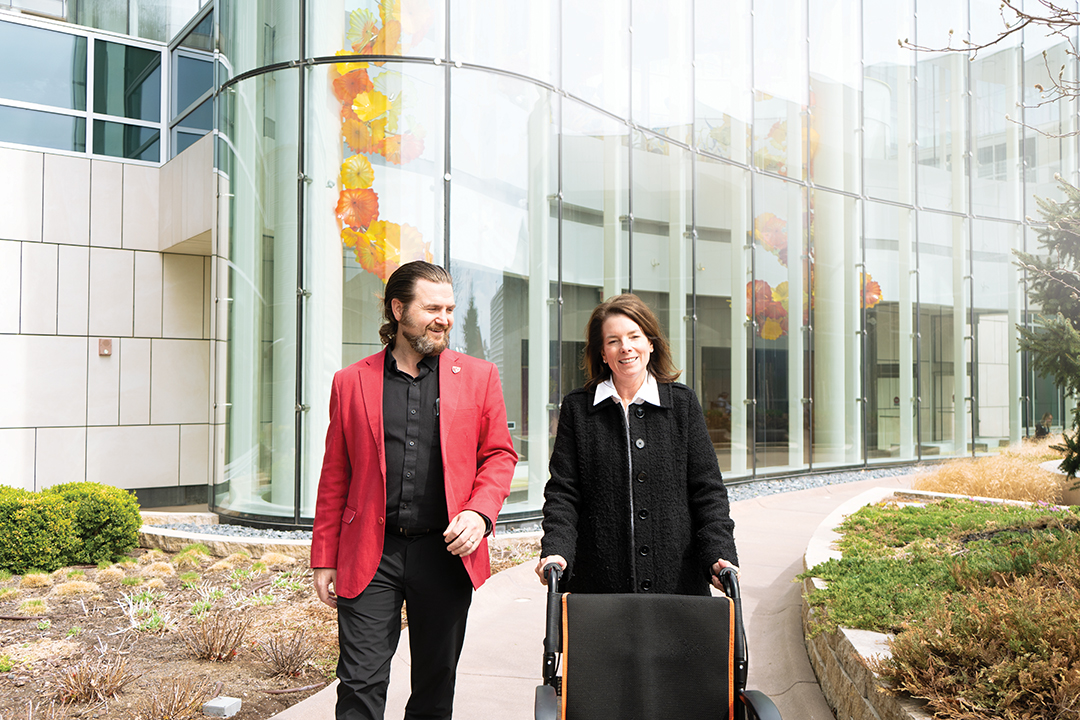
Since receiving the infusion of T cells, Smith has experienced changes that are “completely noticeable.” She can tap her toes on both feet — something she couldn’t do before. She remembers demonstrating the change for Dr. Lunning.
“I was sitting in my wheelchair, and Dr. Lunning came in and hopped up on the exam table. I tapped my toes, and he said, ‘Beth, can I record your toe tapping?’ And I said, ‘Absolutely.’
“It showed that he cares,” Smith said. “He wants what I want. He’s all in.”
SHORTENING THE DISTANCE FROM QUESTION TO ANSWER
Dr. Lunning is passionate about “breaking down barriers” so that researchers and clinicians can quickly bring their innovations to patients like Smith.
“As the medical director of the UNMC Clinical Research Center, I want to make research easy for people on our campus,” said Dr. Lunning. “I want to shorten the distance between question and answer.”
Philanthropy has been key in helping Dr. Lunning achieve that goal. Dr. Lunning was recently named the inaugural holder of the James O. Armitage, MD, Chair in Hematological Malignancies at UNMC, which was created through the generosity of donors.
“Holding this chair is a great honor, and the support it provides is crucial for advancing gene and cellular therapy at UNMC and recruiting the next generation of world-class researchers and clinicians,” Dr. Lunning said.
For Smith, the impact is deeply personal.
“To have this opportunity to support research and make a difference for everyone in the MS community has been life changing,” she said. “It continues to be one of the greatest experiences of my life.”